
Tori no Ichi 2024: Raking a Fortune on an Empty Tank

The Tori no Ichi festival at Hanazono Shrine should have been the highlight of my week. Instead, it was a test of will. I was determined to capture the magic of this legendary night market. But overwhelming crowds and bone-deep exhaustion turned the festive atmosphere into a blur. Yet, even on a night like this, when you feel you have nothing left to give, stories are still to be found.
An exhausting start to the Tori no Ichi
My Friday had already been a marathon. After a full day of work, I rushed to Rikugien Gardens for its Autumn Light-Up Festival. Now, standing near Shinjuku’s Yasukuni-dori, I was running on fumes. The area around the famous Don Quijote store was already a sea of humanity, all heading for the same destination: the Tori no Ichi at Hanazono Shrine.

A sensory overload in Shinjuku
Also known as the Rooster Market, it’s an annual 24-hour festival held at shrines across Japan on auspicious “days of the rooster.” It’s a time to pray for prosperity and, most famously, to buy a lucky kumade—an ornamental rake to “rake in” good fortune.
The streets were a sensory assault. Smoke from yatai (street stalls) billowed from grills. Sweating cooks churned out takoyaki, yakisoba, and okonomiyaki. The sweet smell of choco bananas mingled with the savory air. The pavement was packed with couples and families enjoying their night out, eating and drinking to their heart’s content. I was just trying to stay upright.

Pushing through the crowds at Hanazono Shrine
Every step through the throng was an effort. I was in such a low-energy state that the festive chaos felt like a personal challenge. Going home was an option, but I couldn’t bring myself to quit. My goal was simple: get festival photos. Even a few would be a victory.

Finally, I reached Hanazono, but the density of the crowd only intensified. Long lines snaked towards the prayer halls. Every available space was filled with people eating, drinking, and celebrating. And then there was the main event: the dazzling market for the kumade.

The dazzling spectacle of the Kumade rakes
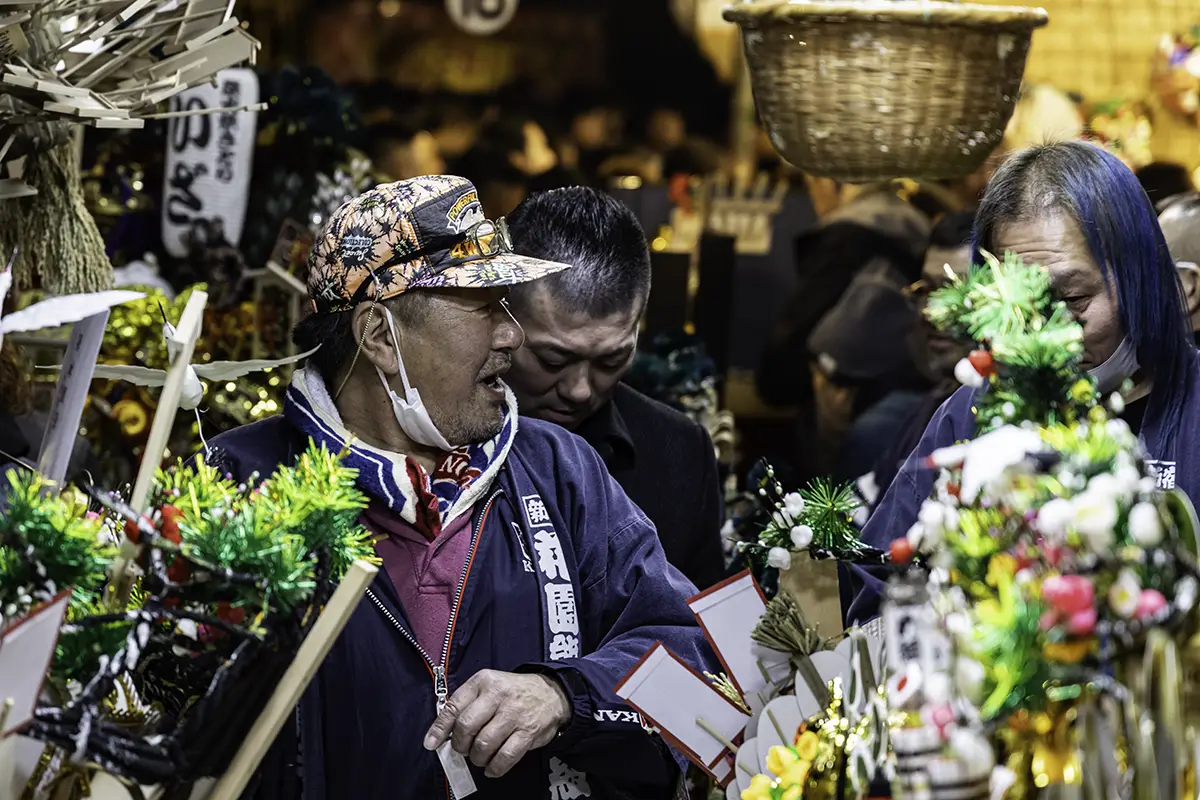
For a moment, the noise faded as my eyes locked onto the brilliant stalls. The kumade, which translates to “bear’s paw,” are ornate bamboo rakes meant to help their owner rake in good fortune and ward off evil for the coming year. The smaller, simpler ones cost a few thousand yen, perfect for first-timers. But the enormous ones, dripping with decorations, symbols, and figurines of deities, can fetch millions. It’s no wonder they are so popular with businesses, which hang them proudly on their walls.

I watched as vendors and buyers engaged in a time-honored tradition. Each time a large kumade was sold, the staff would perform a rhythmic clapping ritual—a lively show of appreciation and a blessing for the buyer. The more expensive the rake, the more elaborate the celebration, sometimes even including a complimentary cup of sake. A fantastic tradition, provided you have a deep wallet!

A small victory and a final lesson
After about forty-five minutes of aimless wandering and taking photos without much thought, I knew I was done. It was a disappointing end to a difficult night. As I turned for home, a small realization dawned on me. Rather than battling back through the main thoroughfare, I took a roundabout side street. It was quiet, clear, and proved to be the quickest way back to the station. A small win, but a welcome one.


Conclusion
That night taught me a valuable lesson. We often face a choice: give in to our limitations and go home, or persevere and get what we came for, even if the results aren’t perfect. On this occasion, I chose to push through. The photos may not be my best, but they are a testament to showing up. The real prize wasn’t a perfect shot, but the simple, hard-won experience of being there.

Q&A: Visiting Tori no Ichi
What is Tori no Ichi?
Tori no Ichi, or the Rooster Market, is an annual festival held on specific “rooster days” in November. People go to pray for good fortune and buy lucky kumade rakes.
When is Tori no Ichi?
Tori no Ichi is held on specific days in November according to the lunar calendar. To avoid problems, consult the shrine’s official website.
How much do kumade rakes cost?
Prices range from a few thousand yen for small, simple rakes to millions of yen for the largest, most ornate ones are purchased by businesses.

Rohan Gillett
Rohan has photographed Tokyo since 2011. He shoots it with his Canon EOS R5. The project will take more than one lifetime to complete.


