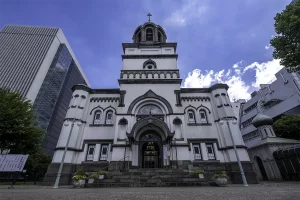


Josiah Conder profoundly shaped Japanese architecture. After arriving in 1877, he was revered for his work and teachings. Many of his students (like Tatsuno Kingo of Tokyo Station fame) were giants of Japanese design. But he wasn’t only an architect.
Japan absorbed much from the West during Conder’s lifetime. Josiah learned in return, becoming a fan of Kabuki and Japanese art. He also learned Japanese dance from Kume Maeba, whom he married.
Did you know he practiced ikebana? He did and also became interested in Japanese landscape and gardening. His work was so good that he wrote books on it.
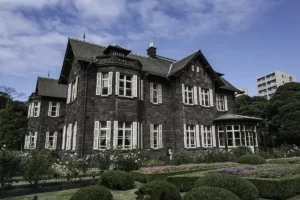
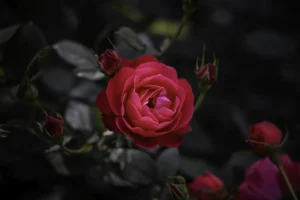
His work can still be seen today in Tokyo. Nowhere is his fusion of Western and Japanese sensibilities more apparent than at the Kyu-Furukawa Gardens. I visited in late May, just as the famous rose festival was ending. Even with the peak bloom past, the garden’s genius was clear. The Western-style mansion provides a stunning backdrop, and the structure of the garden ensures that beauty remains even as the seasons turn. It’s a testament to Conder’s thoughtful design, where the experience is as important as the individual flowers.
Josiah Conder’s impact on Japan extends beyond the blueprints of his buildings. He was a bridge between cultures. Along with introducing Western architectural principles, he became a student and admirer of Japanese traditions himself.
The fact that his books are still read, and his gardens, like the one at Kyu-Furukawa, still draw visitors, speaks volumes. Conder didn’t just design structures. He wove himself into the fabric of Japanese art and life, leaving a rich and multifaceted legacy that continues to bloom today.
Date of Photos: 20 May 2025
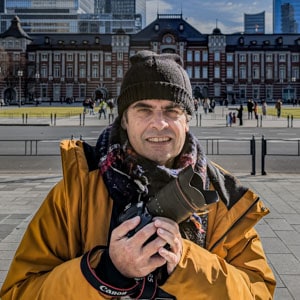
Rohan has photographed Tokyo since 2011. He shoots it with his Canon EOS R5. The project will take more than one lifetime to complete.
External related websites